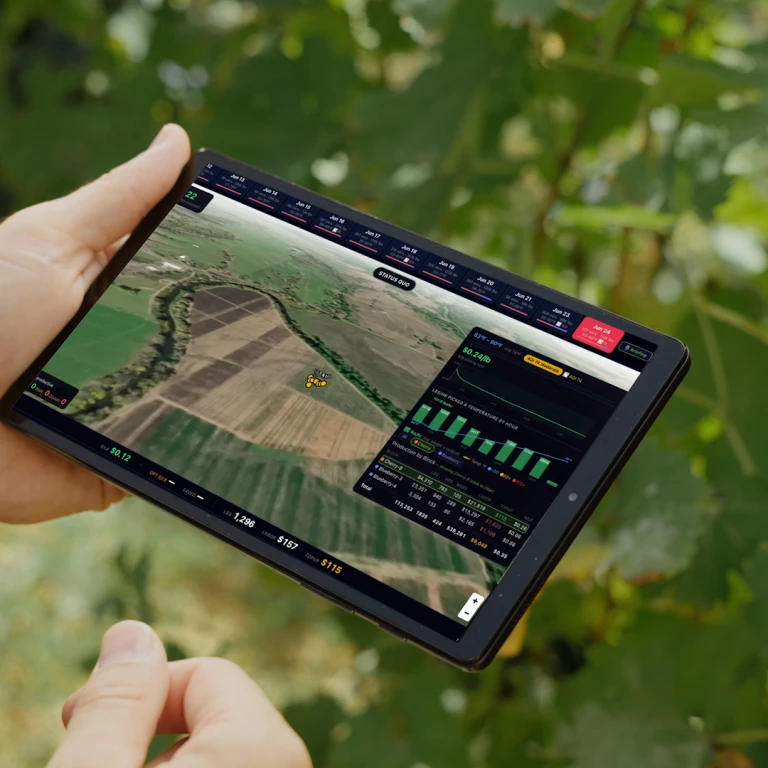
PALM DESERT, Calif. — Supply chain disruptions have increased threefold in the last decade, says Francisco Martin-Rayo, co-founder and CEO of Helios AI, an artificial intelligence-powered intelligence platform that forecasts climate risk and predicts commodity prices.
Martin-Rayo joined Christina Herrick, produce editor for The Packer, at West Coast Produce Expo 2026 for a discussion of how technology can help the fresh produce industry weather the storm amid global instability.
“You’re looking at things that are 10 times faster and 10 times cheaper than ever before,” he says. “And making sure that folks in our industry are able to take advantage of that innovation is really important.”
The Geopolitical Threat to Global Fertilizer
He says that while the U.S. produces 70% to 75% of the country’s domestic fertilizer supply, other countries such as Australia depend on Qatar, which supplies about 70% of the global fertilizer needed. In March, Iranian missiles struck the Ras Laffan Industrial City, and the Qatar Fertiliser Co. suffered extensive damage.
Martin-Rayo says that while the domestic fertilizer supply might not be as impacted by the unrest, the effects globally are yet to come. The plant, which will likely be down for the next three to five years, will affect the global fresh produce supply in a much broader sense.
“The fact that so many countries around the world are now no longer getting the fertilizer they need is going to be an enormous issue,” he says.
Fertilizer availability will greatly impact Southern Hemisphere production, whose growers will need inputs in September, October and November. What will likely happen, Martin-Rayo says, will be that growers will opt for crops that use less fertilizer.
“You’re going to have lower production, lower yield, and that’s when it starts to become less of a price sensitivity and more of an availability perspective,” he says. “You’re really going to start to see a lot of the pain in Asia and South America as you go into their planting seasons in a way that we haven’t experienced it yet.”
A Shift Toward Fragmented Global Markets
Martin-Rayo says that it’s going to be a while before global economics get back to normal and shipments resume through the Strait of Hormuz. The first shipments, too, won’t be fertilizer but oil, as it’s the most profitable and economic shipment to prioritize.
“Our view is it is going to take us certainly through this year, if not longer, to get back to the point where you start to see the transport of fertilizer again to the countries that really need it in South America and Asia,” he says. “If we’re looking outside the United States at the places we’re sourcing from or the places we’re competing against, it’s something to really keep top of mind how that’s going to impact both prices, availability and our pricing power here in the United States.”
And with all this global instability, it’s likely markets will become fragmented with multiple pricing blocs, instead of the one-price system in place currently.
“As you’re looking at sourcing internationally, we’re starting to see more countries try and lock up that type of supply based on almost bilateral conversations, especially the folks in the Middle East, China, where they’re saying, ‘Hey, instead of buying on the open market, we’re going to give you a particular commitment, not just monetary, but in some cases political to make sure that we’re getting the supply that we need.’”
Empowering Lean Procurement Teams With AI
This builds to Martin-Rayo’s point that while supply chain disruptions in fresh produce have increased three times in the past decade, procurement teams have not increased at the same rate. Technology, he says, helps small teams become more efficient.
“I think one of the things that’s been really interesting for us is the level of instability has increased dramatically,” he says. “One of the things that general AI is really good at is able to ingest billions and billions of data points and then tell you the things that you need to worry about.”
Ag is primed to benefit from AI in terms of innovation and productivity, Martin-Rayo says, noting, “Agriculture to us is both the most hopeful and probably most difficult industry in the world.”
He says that when everything goes right, it’s great, but if everything goes wrong, the grower is out of luck.
Martin-Rayo highlighted how a couple of farms, including Taylor Farms and The Wonderful Company, use technology to improve productivity. Taylor Farms uses AI to identify lettuce heads in the field to double the speed of packing. Wonderful uses trunk sensors to detect the moisture and evapotranspiration in the tree for precise irrigation.
“Farmers are incredible at being early adopters once the ROI is clear,” he says. “You’ve only got 40 seasons, give or take, and so it takes a lot to say, ‘I’m going to put one of these seasons at risk.’ You don’t need to do that. You can test cheaply and earlier than before, and then once the ROI is proven, at least in our experience, farmers are really, really good at innovating. You just need to get through that initial hump. It’s cheaper than ever to do the initial hump.”
How Produce Businesses Can Get Started
Martin-Rayo says it’s no longer such an investment to find customized solutions for a produce industry business. The speed of innovation and technology is at a place where it makes economic sense to build customizable platforms for an individual produce business. And data no longer has to be built in the same structure to be useful.
“The beauty of AI today is that you can actually input 10 different types of data across 10 different structures and artificial intelligence is able to rationalize it and give you the insights that you need,” he says. “The data has to be good, but you don’t have to spend the time anymore making sure it’s all in one system, making sure it’s all tagged the same way. Artificial intelligence does that really, really well from quantitative and qualitative data.”
Martin-Rayo says a key takeaway is that the best way to get started with AI is to identify one decision that is extremely costly when it’s wrong and automate that decision to provide ROI. Second, he says, is to test fast and then pair the technology with one champion to help build out solutions internally.
“One of the interesting things is data, proprietary data especially, has become more valuable than ever,” he says. “You can get incredible insights using public data now. When you’re looking at proprietary data, make sure it’s good and protected. Leverage a lot of these new tools on your own data to get better results.”