

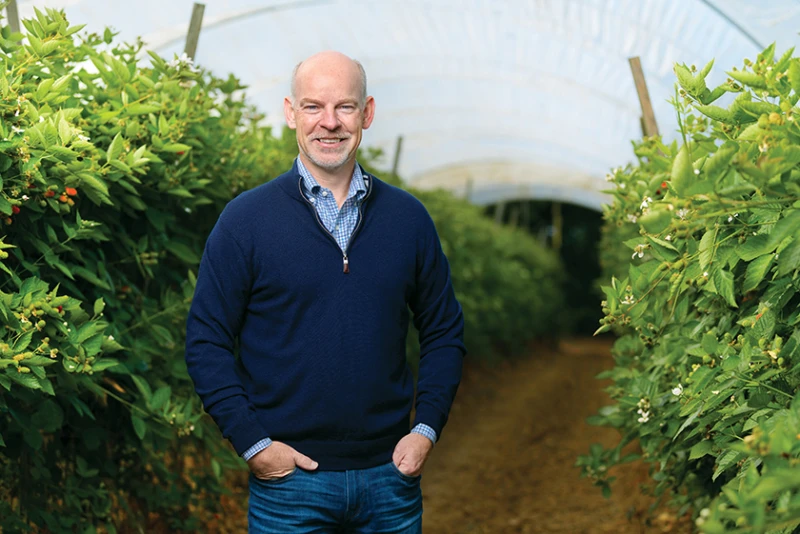
The fresh berry category has cemented itself as the heavyweight champion of the produce aisle, with 25% of all fruit sales coming from berries. Speaking at the Wall Street Journal’s Global Food Forum in Chicago on June 2, Driscoll’s CEO Soren Bjorn revealed that retail berry consumption has surpassed a critical threshold.
“Berry consumption has been going up for a very, very long time,” Bjorn says. “It was the first time we went through $10 billion as a retail category last year. If I compare it to the second largest produce category, it’s grapes, and that’s $4.5 billion, something less than half.”
Despite this dominant market position, navigating a global berry operation means balancing a delicate mix of genetics, labor volatility, trade policy and shifting consumer trends.
The Economics of Flavor: Keeping Premium Genetics in the Pool
A significant driver of recent growth has been the emergence of the super-premium berry segment, such as Driscoll’s Sweetest Batch line. Eight years ago it was a “nothing business,” Bjorn says, but the industrywide super-premium category grew to nearly $700 million last year, with Driscoll’s accounting for roughly $400 million of that total.
Developing these high-end varieties requires a substantial operational investment and a willingness to buck traditional agronomic metrics.
- The yield trade-off — “If you want more sugar, and that’s a lot of times associated with more flavor, then you lose some of the biomass. So, it’s just less weight, less productivity,” Bjorn says. “The energy of the plant goes to produce sugar and not to produce mass, and so the highest flavored berries tend to be lower yielding.”
- The breeding pipeline — To capture those rare exceptions, Driscoll’s runs an extensive breeding program. “This year we will make 125,000 new strawberry varieties, and hopefully we find one or two in eight years that’s worth sending out to all of you,” he says.
By creating a premium price tier, Driscoll’s can financially sustain these low-yielding, high-flavor genetics rather than discarding them early in the trial phase. This strategy ultimately elevates the flavor profile of their standard “yellow-label” berries by keeping superior flavor genetics active in the breeding pool.
Navigating the Noise: Standing Firm Through Pesticide Activism
As a high-profile brand, Driscoll’s occasionally finds itself in the crosshairs of politically motivated consumer watchdog groups, Bjorn says. He addressed a recent online controversy where an activist blog tested strawberries for pesticides, explaining that such events are often deeply intertwined with broader legislative and local battles.
Bjorn notes that the online flare-up coincided with a Supreme Court case, farm bill negotiations, a new California State Assembly bill regarding PFAS chemicals and local efforts in the state’s Santa Cruz County to prevent conventional farming near schools.
“The strategy of the activist is also well known, right? You go after the brand because you can’t go after the regulator,” Bjorn says. “They’re sort of an anonymous group, so you go after the brand and you try to get the brand to take action, and you know it’s not fun when you’re in it ... but we’ve got to stay true to who we are, and the good news here for us is that there’s absolutely no truth in this, right? But there’s an attempt to try to change, you know, an agenda that’s very political, and sometimes the brands get caught up in that.”
When asked if the viral controversy had any lingering impact on Driscoll’s bottom line, Bjorn responded with a definitive no.
Labor and the ‘Two-Week’ Supply Chain Reality
The manual nature of the berry harvest means the industry remains deeply vulnerable to immigration policy and labor availability. During peak periods in North America, Bjorn stated that approximately 125,000 individuals are hand-harvesting Driscoll’s berries.
Addressing the enforcement atmosphere and the legal status of the agricultural workforce, Bjorn pointed out the fragility of the current system: “We have not seen significant, or even any, ICE raids on berry farms in California ... I think [there] is an understanding within the administration that if they go after this workforce, it will be literally two weeks before we run out of certain products. It will take two weeks. It’s not hypothetical.”
Because fresh berries have a rapid inventory turnover — turning roughly 300 times a year with no standing inventory — any sudden disruption at the farm level hits retail shelves almost immediately.
“What comes in today is hopefully out tomorrow,” Bjorn says.
Trade and Tariffs: A Warning on USMCA
With the agricultural review for the United States-Mexico-Canada Agreement underway, Bjorn expresses a firm stance on cross-border trade: “In fresh fruits and vegetables, we wanted to leave it the way it is.”
To illustrate the danger of protective tariffs on low-margin produce categories, Bjorn points to the recent expiration of a 30-year-old tomato suspension agreement, which reinstated a 17% tariff and ultimately led to the cost going up by almost 30%.
Bjorn warned that applying similar tariffs to berries or other fresh produce would be a “terrible, terrible policy from a resiliency standpoint, from a supply standpoint, from an affordability standpoint.”
Emerging Demand Drivers: GLP-1s, C-Stores and Employee Coverage
Looking ahead, Driscoll’s is tracking shifts in consumer behavior, including the rise of GLP-1 weight-loss medications. While some analysts fear a drop in overall food volume, data suggest health-focused categories stand to win.
According to data shared with Bjorn by Kroger, GLP-1 patients are advised to focus heavily on nutrition and protein to avoid malnutrition. As a result, fresh produce and premium meats are seeing significant demand lifts.
“We have a chart that just came out in our company, and you could see the increase in demand of berries up until the day the GLP-1 drugs got introduced, and that chart went up at a river curve,” Bjorn says.
Bjorn’s belief in the long-term societal and healthcare benefits of these drugs has also influenced his internal corporate strategy. After learning at the Milken Global Conference that companies backing GLP-1 coverage saw their overall healthcare costs decline after 18 to 24 months, Bjorn approached his human resources team to expand coverage for Driscoll’s employees.
When the interviewer noted that 100% coverage seemed like an unexpected financial vision for a CEO, Bjorn says he pointed to the future affordability of the market and stated that next year the drug would be free for its employees.
Driscoll’s is also looking to capture more snacking occasions — which currently account for 40% of consumer calories — by rethinking packaging for segments like convenience stores. The company is currently scaling a Rainbow Pack nationally, featuring separate, pop-out compartments for blueberries, blackberries and raspberries to offer on-the-go convenience.
Merchandising: The Final Frontier
When asked how he would allocate investment across genetics, supply chain and merchandising, Bjorn maintained that genetics “overwrites it all” because it defines the brand’s eating experience. However, he emphasized that retail merchandising remains a massive, untapped opportunity.
“Twenty-five percent of all fruit sales today in retail comes from berries. It is the single largest category in the entire store,” he says. “Most of the retail CEOs know that their No. 1-selling item in the entire store goes to 1-pound or 2-pound strawberry, right? It is the first metric they want to see Monday morning because that is the indicator of how they did in the entire store.”
Despite this, Bjorn notes that berries are still frequently left out of the primary entryway displays in many supermarkets, urging industry partners to continue pushing retailers to give the category the prominent real estate its sales volume deserves.



