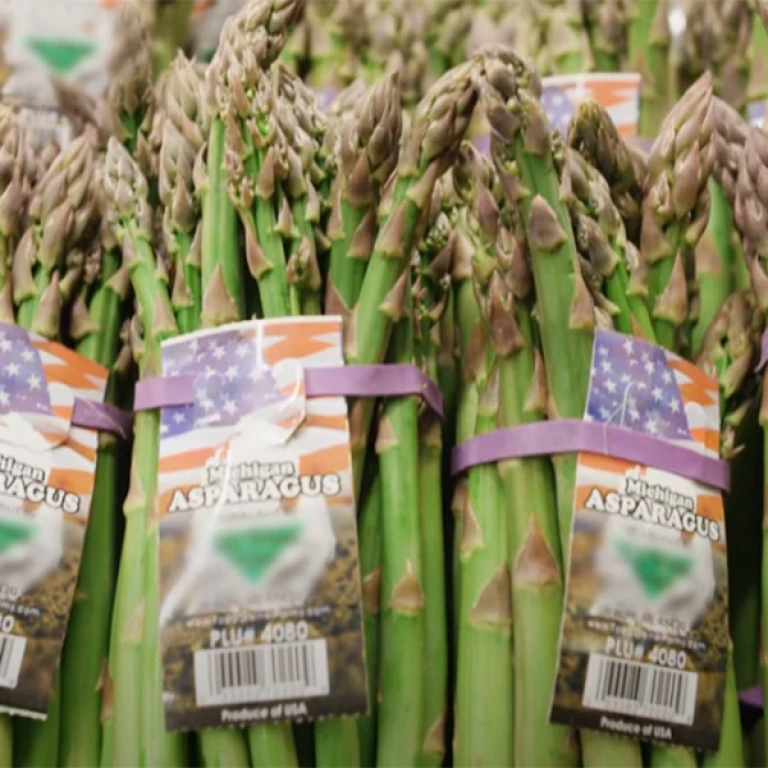
U.S. shoppers are buying more fresh asparagus than ever, and a growing share of the vegetable is supplied by imports.
The USDA’s per capita vegetable availability numbers for fresh asparagus show growth from 0.81 pounds in 2000 to a high of 1.78 pounds in 2021. Per capita consumption in 2022, the latest year with statistics available, fell slightly to 1.53 pounds, according to USDA numbers.
Imports supplied about half of the total asparagus supply consumed in the U.S. in 2000 (51%), but that number has continued to rise since then. Imports accounted for 68% of the total U.S. asparagus supply in 2005, climbing to 85% by 2010, 90% by 2015 and 94% by 2022.
Circana retail scan data for the 12 months ending Jan. 28 this year showed total asparagus sales were $767.7 million, down 5.4% compared with the previous year. Conventional asparagus sales accounted for 95% of total sales, with organic sales contributing 5%.
Organic asparagus sales for the 12 months ending Jan. 28 were $37.2 million, up 6.9% compared with the prior year. Conventional asparagus sales totaled $730.4 million, down 6% compared with the previous year.
Circana data indicated all retail asparagus volume was down 12.7%, with conventional supply down by 13.7% and organic volume up 10.2%.
The average unit price for all asparagus was $3.25, up 8.3% compared with the previous year. Circana reported that average organic unit pricing was down 3%, while average conventional unit pricing was up 9%.
The Packer’s Fresh Trends 2024 survey of more than 1,100 consumers, conducted in October 2023, showed 37% of all consumers reported they purchased asparagus in the past year.
Higher-income consumers more frequently reported purchasing asparagus, with 49% of consumers earning more than $100,000 annually indicating purchases. That contrasts with 18% indicating purchases for consumers making under $25,000 a year.
Households with three or more dependent children reported a purchase rate of 46%, substantially higher than households with no kids (35%), according to Fresh Trends 2024.
Western U.S. consumers were the most likely to report purchases (41%), while the South had the lowest reported purchase rate (34%) among U.S. regions, according to Fresh Trends 2024.
Older consumers reported higher purchases of asparagus than younger shoppers.
Consumers in the 50-59 age group had the highest purchase rate (47%), while the 18-29 age group had the lowest (25%), according to Fresh Trends 2024.