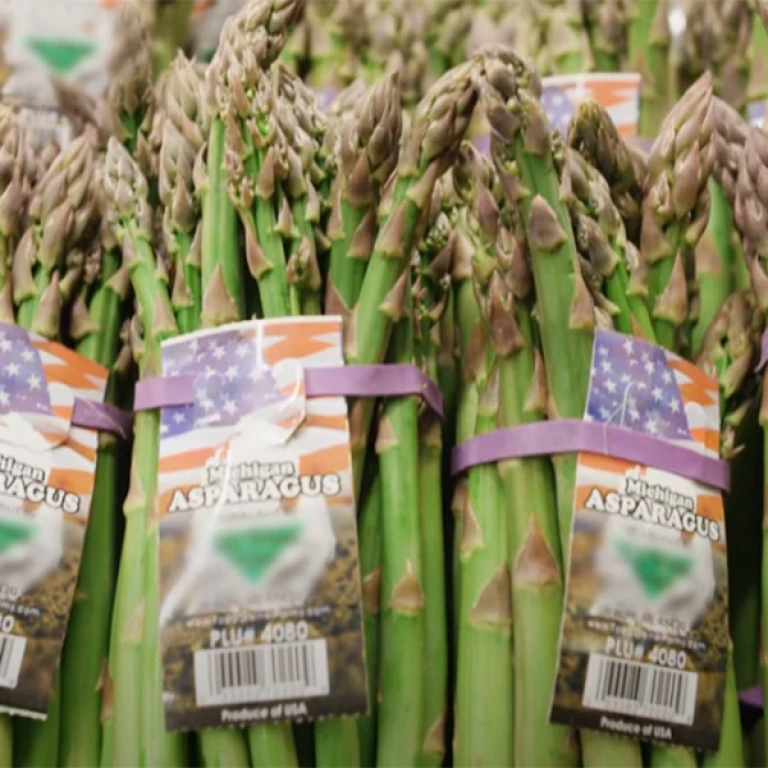
Importers report good volume and quality for Peruvian asparagus, with interest expected to tick up as production in numerous other regions finishes up.
“Demand for Peruvian asparagus early in the year faded fast due to an early Mexico crop,” Walter Hoffman, asparagus commodity manager for Eden Prairie, Minn.-based Robinson Fresh, said June 23.
“Demand for Peruvian asparagus is typically flat in April, May and June. As domestic production from New Jersey and Michigan come to an end this month, demand for Peruvian asparagus will continue to improve and should remain steady through the end of the year.”
In 2017, Peru accounted for about half of all U.S. asparagus imports, compared with 47% from Mexico. Peru exports asparagus to the U.S. year-round, with peak shipments from September through December.
Katiana Valdes, director of marketing for Miami-based Crystal Valley Foods, noted that prices have reflected more production elsewhere.
“The market has been lower this year, compared to last year, due to an increase in the volume of product coming via container as well as an increase in Mexican and domestic production,” Valdes said June 14.
Jeff Friedman, president of Fort Lauderdale, Fla.-based CarbAmericas, gave a similar take June 15, noting that asparagus from New Jersey, Canada, Michigan, Washington and Mexico was receiving preference.
As fall approaches, however, the prospects for Peruvian product improve.
On July 20 the U.S. Department of Agriculture reported f.o.b. prices for 11-pound cartons of bunched asparagus from Peru at $17.50-18 for standard size and $18.50-19 for large.
Prices from June 15 showed the effects of domestic production on demand for Peruvian asparagus. The USDA reported prices were mostly $12 for 11-pound cartons of standard size and mostly $13 for large.
“Volume and quality are looking good,” Valdes said. “We expect similar volume compared to last year.”
Hoffman also had high expectations for the product.
“The crop is very good and our program looks very good,” Hoffman said. “We will likely see an increase in volume due to strong grower relationships and an overall steady Peruvian season. Quality is looking excellent.”
Priscilla Lleras-Bush, coordinator of the Peruvian Asparagus Importers Association, also gave a positive outlook for the season.
“We are looking forward to a steady crop that will yield U.S. retailers and foodservice with quality asparagus, reliable commitments and confidence that they can stock their produce shelves with Peruvian asparagus,” Lleras-Bush said June 19.
While Peru has year-round asparagus production, peak availability is October through December, Hoffman said.
Importers noted transportation as an area to watch this season.
“As an industry we see probably air freight cargo space being a problem,” Friedman said. “Last year planes were not widely available and (there were) higher freight costs, and I think this year air cargo prices are going to be a little higher as well, especially now with fuel prices going up.”
Hoffman noted the electronic logging devices mandate for truckers will also play a role.
“E-logs have certainly created opportunities,” Hoffman said.
“Many asparagus shipments are LTL, making forward consolidation and distribution hub and spoke delivery models increasingly attractive for customers interested in more frequent and timely deliveries per week.”