
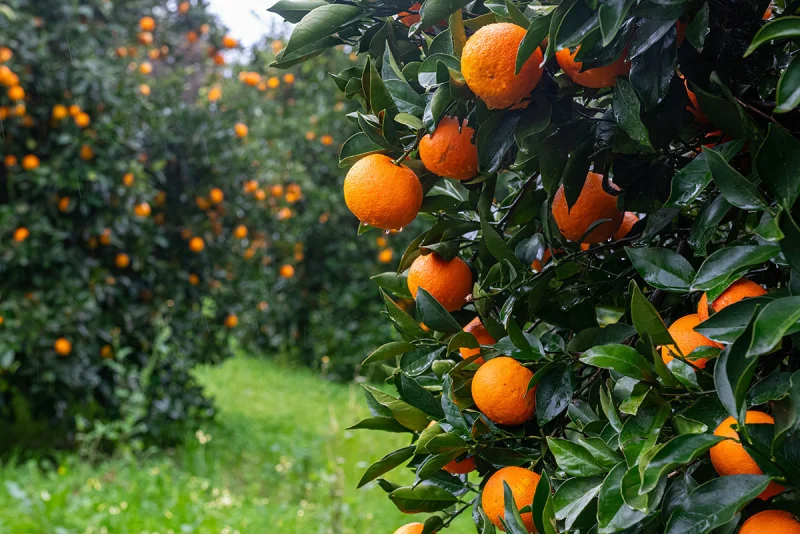
The 2024-25 U.S. citrus crop looked promising in early January with overall good quality.
Total U.S. volume of oranges was forecast at 60.3 million boxes, down slightly from 61.5 million boxes last season, according to the USDA’s National Agricultural Statistics Service January forecast, conducted in cooperation with the Florida Department of Agriculture and Consumer Services.
Grapefruit volume was forecast at 7.4 million boxes, down from 8.5 million last year, and the lemon forecast was at 27.5 million boxes, up slightly from 27.2 million last season.
In the tangerines/mandarins category, volume for the current season was estimated to be 25.3 million boxes, up from about 24 million boxes last year.
“We’ve got a good crop this year,” said Casey Creamer, president of Exeter-based California Citrus Mutual. “Things have been positive so far.”
California’s early-season navel oranges were smaller than usual because hot summertime temperatures extended into October, he said,
Growers had to size-pick to meet market demand.
Average to slightly above-average rainfall in Northern California helped improve size a bit as the season progressed, but citrus, as well as other commodities, still were running “a little on the smaller size” in January, Creamer said.
The 2024-25 California Navel Orange Objective Measurement Report from the California Department of Food and Agriculture forecast the current season’s volume in the Golden State to be 78 million 40-pound cartons, up 2% from last year.
“Things are progressing” in Florida, said Matt Joyner, executive vice president and CEO at Lakeland-based Florida Citrus Mutual.
Hurricane Milton blew across 70% of the state’s most productive citrus acreage in October, he said. “We are in recovery mode from that.”
The state’s growers got off to a slow start on early orange varieties, with a lot of fruit hitting the ground, he said.
“We’re optimistic that things will pick up a little bit as we get into the late varieties,” Joyner said.
There’s not as much fruit on hand as growers would to see like post hurricane, but the quality is good, he said. “Everything is sizing up fairly well.”
USDA expected to see 7 million 90-pound boxes of valencia oranges out of Florida this season and 5 million boxes of non-valencias.
USDA forecast about 1 million 85-pound boxes of grapefruit from Florida, and Joyner expected about 500,000 boxes of specialty citrus, including lemons.
Texas, where red grapefruit accounts for up to 65% of the citrus crop, continues to rebound from a hurricane in 2020, a freeze in 2021 and a series of droughts, said Dale Murden, president of Mission-based Texas Citrus Mutual.
“We’re about half the crop that our normal average is,” he said.
Quality, size and prices are all good this year.
“We’re clawing our way back,” he said.
USDA forecast the Texas 2024-25 grapefruit crop at 1.2 million 80-pound boxes, down from about 1.8 million last year, and estimated the orange crop to be 900,000 90-pound boxes, down from about 1.1 million last year.
All three states are combating citrus greening disease, which was confirmed in Florida in 2005 and has since been discovered in parts of Texas and California as well. Citrus greening, also called huanglongbing or HLB, is spread by Asian citrus psyllids.
“We finally do have more tools in the toolbox that are showing some real improvement in tree health and in the ability to suppress psyllids and the greening bacteria in our trees,” Joyner said.
Ultimately, the “silver bullet” will be a tree developed through breeding that is resistant to greening, he said.
The California citrus industry has done a good job of controlling psyllids, Creamer said. Although greening disease hasn’t affected the state’s commercial groves, citrus greening is something growers remain vigilant about, he said.
“It’s a constant struggle to keep that vigilance and also continue to keep the public informed of the seriousness of this threat to the California industry and the threat across the U.S.,” he said.
Murden said Texas growers have picked up some tree nutrition and fertilization techniques to fight greening from Florida growers and so far have managed to “stay a little bit ahead of it.”
“There’s no cure for it, but we’re keeping the psyllid population as low as we can, and keeping the trees as healthy as we can,” Murden said.



